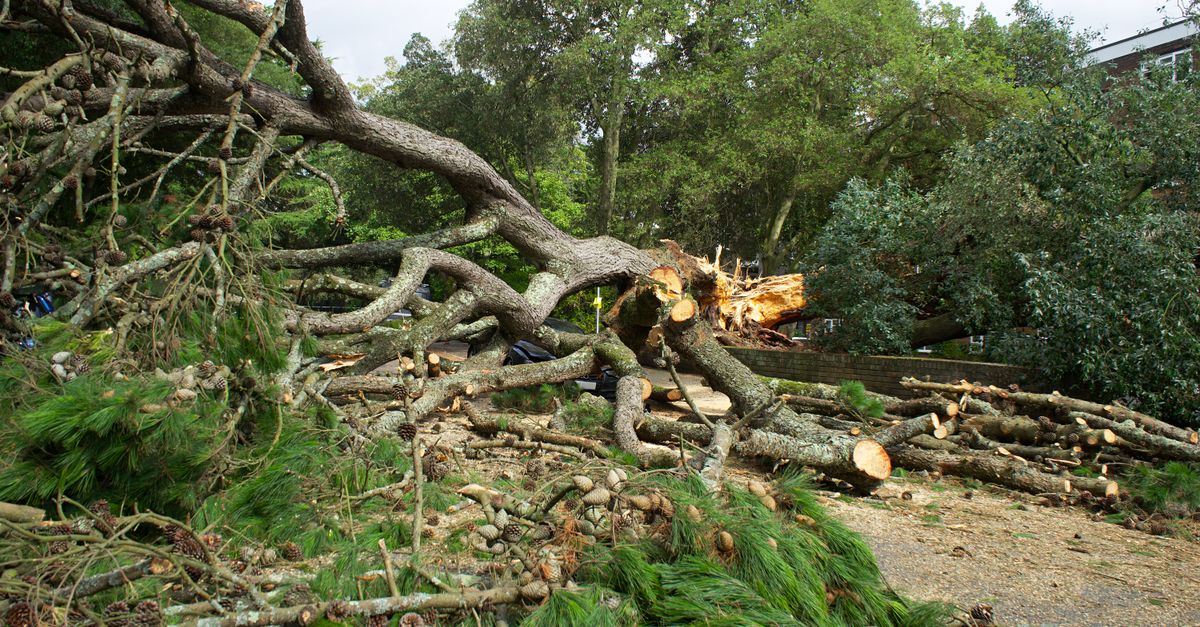
Will Home Insurance Cover Tree Removal in Ontario?
Ontario home insurance may pay for tree removal — but only when a storm-felled tree damages an insured structure. Learn what's covered, what isn't, and how to file your claim.
Home insurance in Ontario will typically pay for tree removal only when a tree falls due to a covered peril — wind, lightning, ice, or storm — and actually damages an insured structure like your house, garage, fence, or shed. If the tree lands in your yard without hitting anything, removal costs are usually on you.
That one sentence answers most of the questions Ontario homeowners are searching for. The rest of this guide explains the limits, the exclusions, the neighbour question, and exactly what to do in the first hours after a tree comes down.
What Ontario Home Insurance Actually Covers
Standard Ontario home insurance policies treat fallen-tree damage as a property claim, not a tree-service claim. The distinction matters enormously.
When a covered peril (storm, ice storm, lightning, wind) causes a tree to fall and that tree damages an insured structure, your insurer will generally pay for:
The key phrase is "damages an insured structure." According to arborist and insurance guidance specific to Ontario, most policies cap the tree-removal or debris-removal portion of a claim at roughly $500–$1,000 per tree, even when the structural repair itself is covered to the full policy limit. Check your policy's declarations page for your specific sub-limit — it is often buried in the "additional coverages" or "debris removal" section.
What Insurance Will Not Pay For
This is where homeowners are most often caught off guard.
Tree falls in the yard, no structure hit. If a storm drops a large maple across your lawn and it misses every building, the removal bill is yours. Ontario home insurance policies do not cover tree removal when no insured structure is damaged, regardless of how large or dangerous the tree was.
Routine, preventive, or maintenance removal. Cutting down a healthy tree, removing a dead tree before it falls, or treating a diseased tree are all considered normal home maintenance. No standard home insurance policy covers these costs, and filing a claim for them will almost certainly be denied.
Neglect. If an insurer's adjuster determines that a tree was visibly dead, diseased, or structurally compromised before the storm — and that a reasonable homeowner should have had it removed — the claim can be denied on the grounds of neglect. This is a real risk with large trees close to your house. Addressing problem trees proactively is both safer and smarter from a coverage standpoint.
The tree sub-limit vs. the repair limit. Even when a claim is approved, homeowners sometimes expect the tree-removal invoice to be fully reimbursed. It usually is not. The structural repair may be covered generously; the tree removal itself is almost always subject to that lower sub-limit.
The Neighbour's Tree: Who Pays?
This is one of the most common questions after a storm, and the honest answer is: it depends, and it is rarely simple.
Ontario has no rule that automatically makes a neighbour liable when their tree damages your property. Liability is assessed under ordinary negligence principles. If your neighbour's healthy tree was blown down by a storm, they are generally not liable — the storm is the cause, not negligence. If their tree was visibly dead or rotting and they ignored repeated requests to deal with it, a negligence argument becomes more plausible, but that is a legal matter, not an insurance one.
The practical path for most homeowners: file a claim under your own policy first. Many Ontario home policies cover storm and fallen-tree damage to your own property regardless of whose tree it was or whose fault it was. Your insurer may then pursue the neighbour's insurer through subrogation if negligence can be shown — but that happens behind the scenes and does not delay your repair.
How to Make the Claim: Step by Step
Acting quickly and documenting carefully is what separates a smooth claim from a disputed one.
Choosing a Tree Service Professional in Ontario
Ontario does not have a provincial licence requirement for residential tree service — arboriculture is a non-regulated trade in the province. That makes credential-checking more important, not less.
The primary voluntary professional credential is the ISA Certified Arborist designation, issued by the International Society of Arboriculture. To earn it, an individual must have documented field experience, pass a written exam, renew every three years, complete ongoing education, and sign a Code of Ethics. Importantly, ISA certifies individual arborists, not companies — so ask which specific person on the crew holds the credential, not just whether the company has one.
You can confirm whether an arborist's ISA credential is currently active by searching the ISA's public lookup at treesaregood.org using the arborist's name or certification number.
Beyond ISA certification, ask every tree service professional for:
For a sense of what tree service work costs in Ontario before you start collecting quotes, the Ontario cost guide for tree service professionals is a useful starting point. And when you are ready to compare professionals, you can browse tree service professionals scored across Ontario on ProScore, where the Trust Index blends reputation, credentials, customer sentiment, and business transparency into a single score — so you are not just reading star ratings in isolation.
If your tree damage has also affected your roof, reviewing roofers scored across Ontario is worth doing in parallel, since structural repairs after a tree fall often involve both trades. You may also want to check the Ontario cost guide for roofers to understand what that portion of the repair is likely to run.
FAQ
Will home insurance pay for tree removal if the tree didn't hit my house?
Generally, no. Ontario home insurance policies cover tree removal costs only when a tree falls due to a covered peril and damages an insured structure. If the tree lands in your yard without striking your house, garage, fence, or shed, the removal expense is not covered under a standard policy.
How much does insurance pay for tree removal in Ontario?
The structural repair is covered up to your policy's limit, but the tree-removal and debris-removal portion is almost always subject to a separate sub-limit — commonly in the range of $500–$1,000 per tree, though your specific policy may differ. Check your declarations page or call your broker to confirm your sub-limit before you receive quotes.
Is my neighbour liable if their tree falls on my house in Ontario?
Not automatically. Ontario uses ordinary negligence principles, so a neighbour is only liable if they knew or should have known their tree was hazardous and failed to act. If a healthy tree was blown down by a storm, the storm is typically the cause, not negligence. File under your own policy first — your insurer can pursue the neighbour's insurer separately if negligence applies.
Find contractors now
Compare 16,300+ Ontario contractors with ProScores from 10+ verified data sources.
Search ProScore